
Artificial Advancements (How generative AI changes humanity’s future)
Read Time:3 Minute, 4 Second
By: Adrian Baez
The way more and more people approach tasks that previously required a lot of mental effort is being revolutionized by generative artificial intelligence. AI turns tedious assignments into tasks that can be completed with little to no input.
Many students rely on A.I tools for homework and studying as they become more prevalent in classrooms, workplaces, and daily life. 86% of students used AI in the 2024-25 school year, according to ‘Schools’ Embrace of AI Connected to Increased Risks,’. Research on Al-assisted learning Conducted at the National University of Science and Technology POLITEHNICA Bucharest, reveal challenges such as over-reliance on AI, diminished critical thinking skills, and academic dishonesty.
Since tools like calculators and search engines have been around for decades, the issue is not just that students use technology. Effort, repetition, and problem-solving are essential for learning because they fortify neural pathways linked to memory and critical thinking. When people heavily rely on automated systems, there is a decrease in neurological activity in areas of the brain involved in reasoning and decision making.
Even post high school and college, AI has infected everything, many workplaces have started integrating AI tools into jobs such as burger king with their new AI agent that will listen to orders and coach workers on being hospitable. A McKinsey report projects that by 2030, 30% of current U.S. jobs could be automated, with 60% significantly altered by AI tools. Goldman Sachs predicts that up to 50% of jobs could be fully automated by 2045, driven by generative AI and robotics.
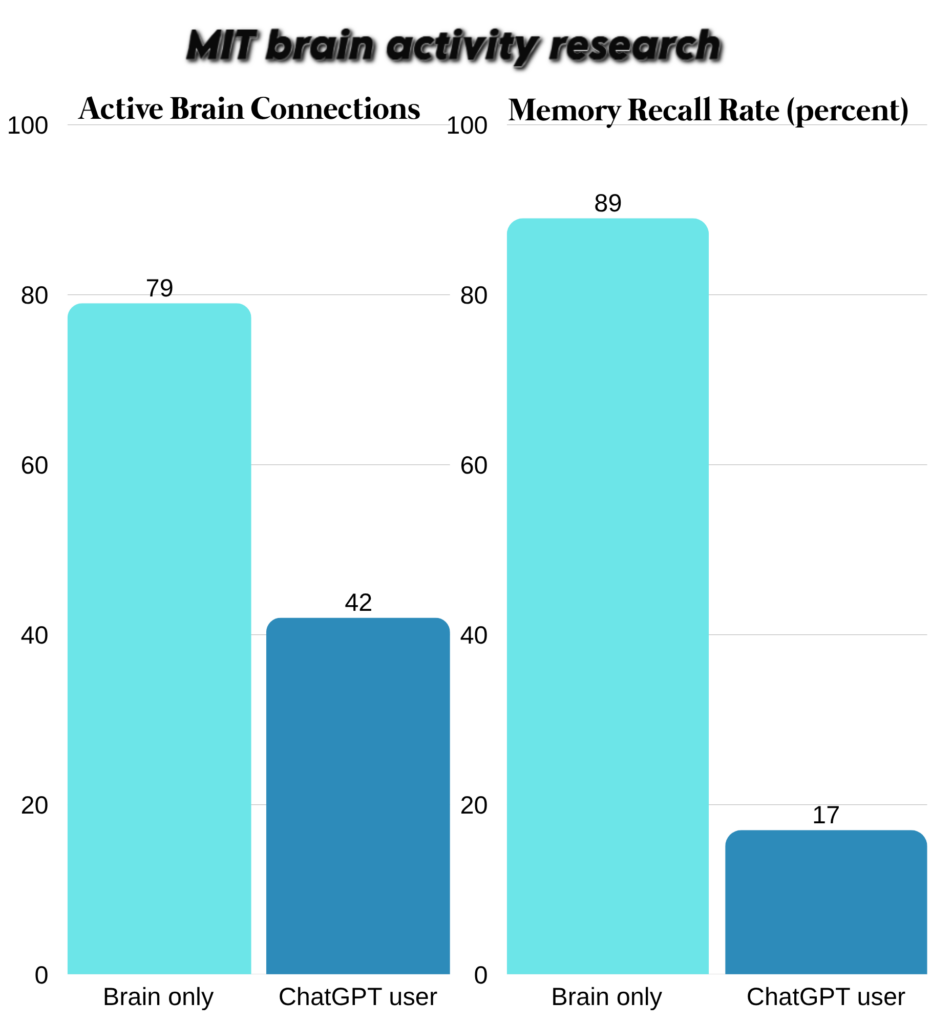
BRAIN BLAST: This shows the effects AI has on the human brain through the amount of connections a person’s brain makes and the rate at which they could recall things. This study was conducted by MIT researchers to discover how large language models affect the human mind
Artificial intelligence also requires large amounts of computer memory to operate. Modern AI models process billions of parameters, meaning they need far more RAM than traditional software. Large AI systems used in data centers can require hundreds of gigabytes or even terabytes of memory to run efficiently. As AI continues expanding, the demand for computer memory has risen significantly, raising the cost of hardware.
Environmental researchers estimate that conservatively, one ChatGPT prompt requires 0.32 milliliters of water through cooling processes, and when multiplied across 2.5 billion daily uses of ChatGPT. The total demand becomes 211,337 gallons (or about a third of an olympic swimming pool) per day. Some projections suggest global AI-related data centers could withdraw billions of cubic meters of water annually within the next few years. It will put a strain on neighborhoods already dealing with limited freshwater supplies.
Supporters of artificial intelligence argue that the technology increases productivity, improves accessibility, and helps students complete difficult endeavors more efficiently. Those benefits are real, especially for brainstorming ideas or explaining challenging concepts. But they come at a cost. When students consistently rely on AI to think for them, they risk losing opportunities to develop creativity and independent reasoning skills essential beyond the classroom.
Generative AI has the potential to greatly increase productivity and efficiency in many fields However, when societies become too dependent on automated systems, there is a risk that critical thinking and creativity begin to decline. Overreliance on AI can also deepen economic inequality as industries automate jobs faster than workers can adapt. If used as a tool to assist human innovation, AI can help improve lives and solve global problems. But if it replaces human judgment, the long-term consequences could reshape workplaces and daily life in ways society may not be prepared for.


Happy
0 %

Sad
0 %

Excited
0 %

Sleepy
0 %

Angry
0 %

Surprise
0 %
 0
0
 0
0