One Giant Leap
Read Time:3 Minute, 27 Second
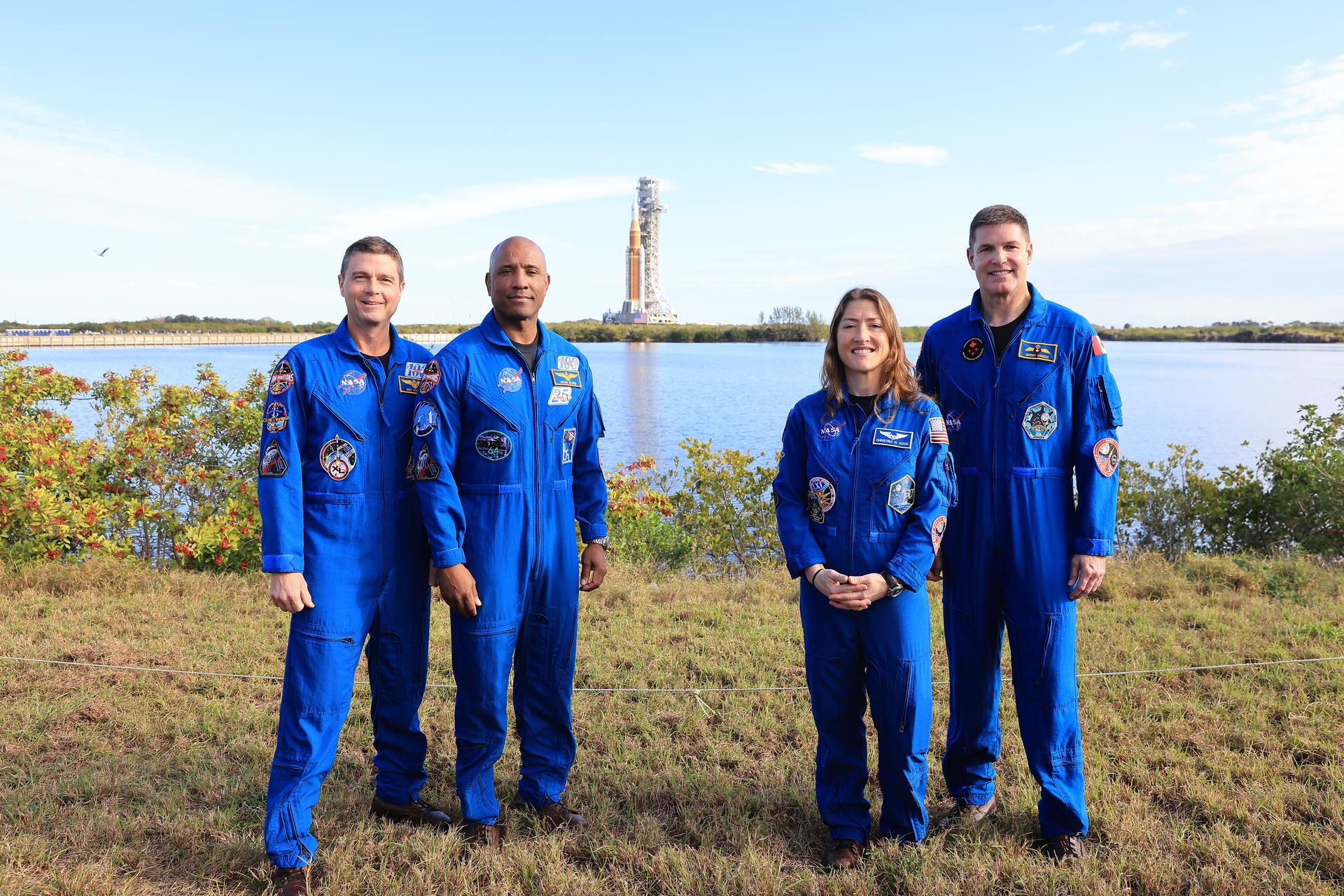
Ready for Takeoff: From left to right, Artemis II NASA astronauts Reid Wiseman, commander; Victor Glover, pilot, and Christina Koch, mission specialist, and CSA (Canadian Space Agency) Jeremy Hansen, mission specialist. Behind them sits the Artemis II rocket on top launch complex 39B. Image Courtasy of NASA/Kim Shiflett
By: Jonathan Gossett
The Apollo program took humanity to its first steps on the Moon. But since the conclusion of Apollo 17, 53 years ago, no human has ever been outside of our gravity well. But NASA is changing that.
On November 16, 2022, NASA launched Artemis I. It began a new era of space exploration. Artemis, the Apollo program’s successor, aims to put boots back on the Moon and eventually Mars. The Program currently has five planned missions to explore the moon’s surface and will culminate with the establishment of a space station orbit the moon.
“As a civilization, We’re very vulnerable here. This is all we got, and if we can expand and have a self-sustaining presence on the Moon, it increases our chances of keeping our civilization going.” Said Nicholas White, West Broward astronomy teacher.
The Artemis I mission circled the Moon once and returned to earth over the course of 25 days. The crew capsule, named Orion, was sent to orbit the Moon with three manikins, affectionately called “Moonikins”. These dummies were equipped with radiation sensors to investigate how the human crew of Artemis II would react in the deep-space environment. The Orion capsule also broke the record for the farthest distance any spacecraft capable of supporting humans has achieved. It reached a maximum distance of 268,563 miles from Earth. The next mission, Artemis II, will take a similar path to Artemis I, but with a living crew. The mission is supposed to take course over ten days and will put the first woman, Christina Koch, and person of color, Victor Glover, into orbit around the Moon.
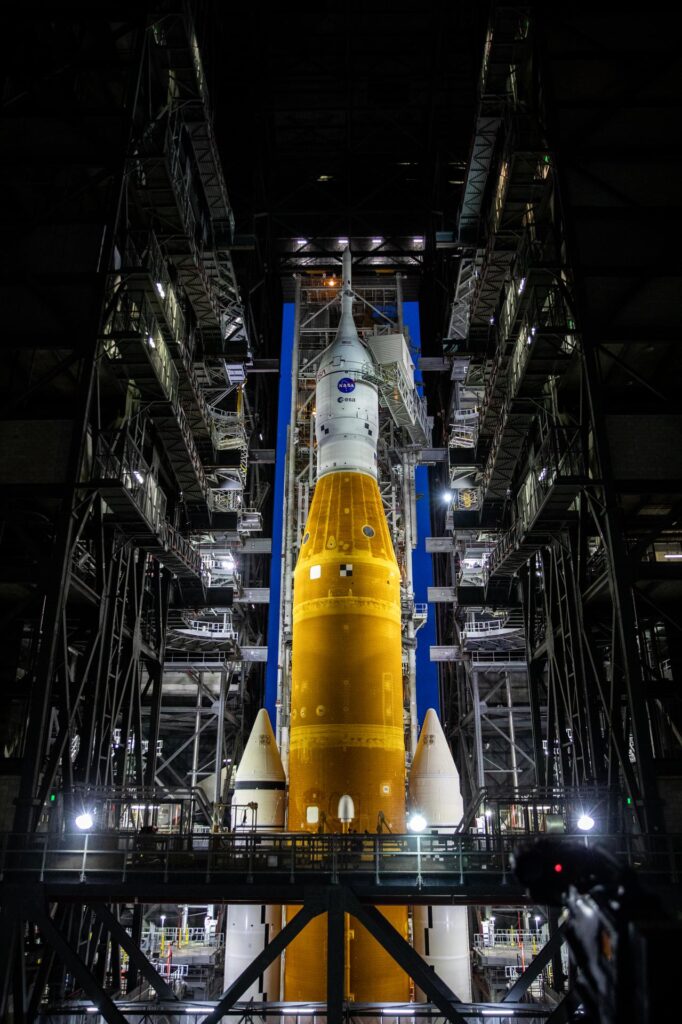
Our Ticket to the Stars: The 322ft tall SLS (Space Launch System) rocket is NASA’s most powerful ship. It is designed to launch over 27 tons of cargo to the moon and will launch the Artemis missions into orbit. Image Credit: NASA/Ben Smegelsky
“More inclusion is a very wonderful development. Considering that more people have come into the US and we have become a melting pot of races. It shows our equality and rights as the United States of America. I find it very honorable that NASA is taking steps towards this,” said Akshaya Ramesh
NASA aims to send humans back to the Moon for many reasons. Besides scientific research, technologies derived from Artemis can trickle back into commercial use and create life-changing innovations. For example, the miniaturized electronics created for the Apollo guidance computer lead to the innovation of digital Fly-by-wire computers that are used in military and commercial aircraft today. NASA calls these technologies “Spinoffs”. According to their 2023 economic report, NASA Spinoffs produced 1,564 new technology reports, 40 new patent applications, 69 patents issued, and established 5,277 software usage agreements. NASA also creates a major economic output. They generated 75.6 billion dollars across all 50 states and Washington, DC and supported 304,803 jobs in the year of 2023.The new Moon missions will also inspire a new generation to explore space, just like the Apollo landings did in the 70’s. Artemis also aims to find ice at the poles of the moon. This discovery would allow for fuel to be synthesized on the moon and would make it a steppingstone to Mars. Having self-sustaining colonies on other planets also safeguards our species against extinction.
“I think this is exciting stepping up in our advancement. It shows how far we’ve come. It’s been a while since we’ve been up there and it really goes to show how we are evolving as a society,” said Ethan Naughton, West Broward junior
As of March 20, the Artemis rocket has returned to launch pad 39B following a repair related rollback. The mission is slated to launch no earlier than April first.


Happy
0 %

Sad
0 %

Excited
0 %

Sleepy
0 %

Angry
0 %

Surprise
0 %
 0
0
 0
0